
WordPress vs. Shopify vs. Custom Website: What Fits Your Business?
1.0 Introduction: The Most Important Decision You’ll Make
Every entrepreneur faces a critical dilemma when bringing their business online: choosing the right foundational platform. This is far more than a technical task; it is a strategic choice that will fundamentally impact your costs, scalability, day-to-day operations, and long-term growth potential. It dictates whether you opt for a “Managed For You” service or a “Self-managed” asset, a decision that shapes your brand’s potential and can be the difference between thriving and struggling.
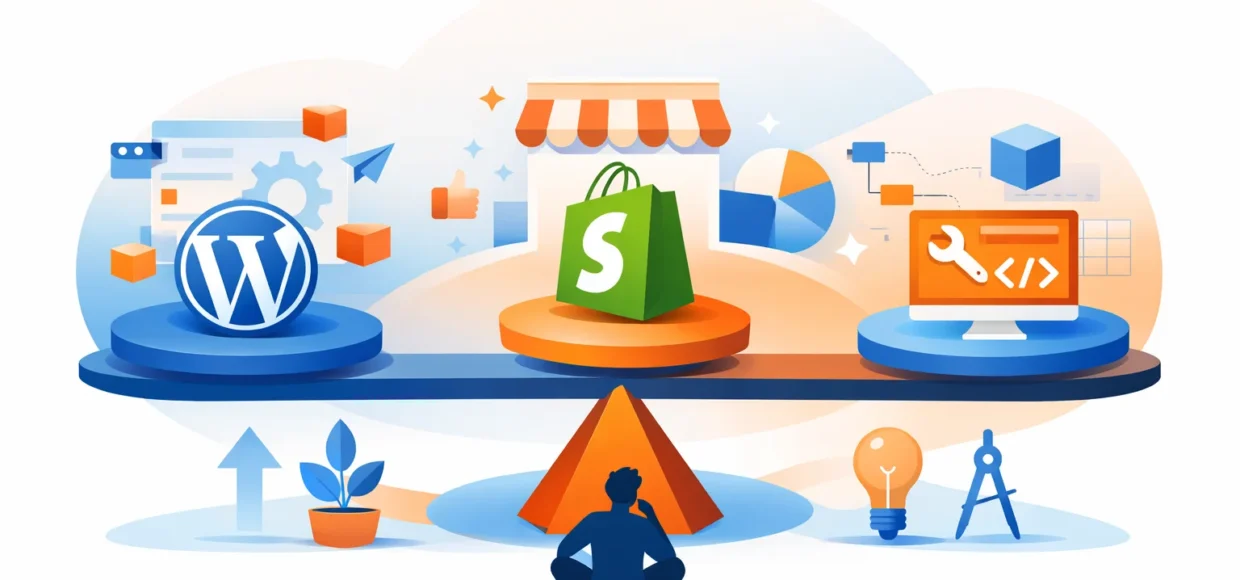
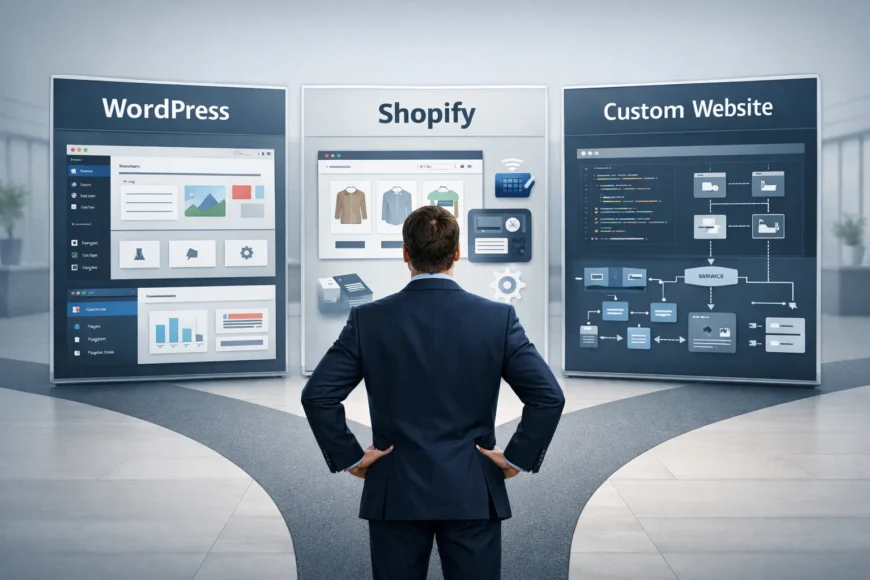
The three main contenders in this arena are WordPress (paired with its powerful WooCommerce plugin), Shopify, and a fully custom-built solution. Each represents a different philosophy: WordPress for ultimate control, Shopify for unparalleled convenience, and a custom solution for absolute precision. The stakes are incredibly high. With research suggesting that a staggering 90% of e-commerce businesses fail within the first four months, often due to foundational issues like choosing the wrong platform, this decision demands careful consideration.
In my experience as a digital strategist, I’ve seen that the “best” platform doesn’t exist in a vacuum. The right choice is less about which one has the most features and more about which one aligns perfectly with your specific business goals, budget, and technical comfort level. This guide will provide a clear breakdown of each option, clarifying their unique strengths and weaknesses to help you make an informed decision for your business’s future.
2.0 Platform Breakdown: Understanding Your Core Options
2.1 WordPress: The Power of Flexibility and Control
WordPress stands as the world’s most popular open-source Content Management System (CMS), a testament to its power and versatility. While it becomes a robust e-commerce engine when paired with the WooCommerce plugin, it’s crucial to understand its modular nature. Its core value proposition is simple yet profound: it offers unparalleled control and complete ownership over your digital presence.
Unlike an all-in-one service, WordPress is a self-hosted and self-managed framework. This means you are responsible for selecting and managing all the core components of your technology stack, including web hosting, security protocols, and software updates. While this requires more hands-on management, it grants you the freedom to build a truly bespoke online store.
While WooCommerce is the most common choice for turning WordPress into a store, the platform’s flexibility allows for other specialized e-commerce plugins. For businesses focused on non-physical goods, a solution like Easy Digital Downloads (EDD) offers a streamlined experience tailored specifically for selling software, ebooks, and other digital products. This modularity is a core strength, allowing you to choose the exact tool for the job rather than being locked into a single system.
Primary Strengths
- Unmatched Customization: With WordPress, you have full access to the source code, allowing for deep modifications. The platform is supported by a massive ecosystem of themes and plugins, and integrates seamlessly with powerful page builders like Elementor or Divi, giving you granular control over every pixel of your site’s design.
- Content and SEO Dominance: Because its foundation is a world-class CMS, WordPress is inherently superior for content marketing. You can create custom post types, design flexible URL structures for topical authority, and leverage powerful SEO plugins like Rank Math or Yoast to implement advanced optimization strategies that are often out of reach on other platforms.
- Full Ownership: You own your data and code completely. There is no vendor lock-in, meaning you are free to move your website to any hosting provider at any time without restriction. This freedom is a critical long-term advantage for any business that values its independence.
- Cost Structure: The pricing model is component-based and highly variable. The core WordPress and WooCommerce software are free. Mandatory costs include a domain name and web hosting, but beyond that, expenses are determined by your choice of premium themes and plugins, allowing you to scale your investment as you grow.
Key Limitations
- The Trade-off for Control: Full Responsibility: This is a conscious decision about allocating resources (time and money) toward asset ownership versus operational simplicity. You are on the hook for managing all software updates, security measures, site backups, and troubleshooting plugin conflicts. This responsibility is not trivial; it’s a common source of stress for non-technical owners and can lead to “2 AM calls” when updates cause conflicts or security vulnerabilities arise.
- Steeper Learning Curve: While user-friendly for content creation, fully leveraging WordPress for e-commerce often requires developer knowledge. Non-technical users may struggle with the initial setup and ongoing maintenance without professional support.
- Performance Management: Your site’s speed is not guaranteed; it is directly dependent on the quality of your hosting provider and your own optimization efforts, such as caching and code minification.
Who is WordPress Best For?
WordPress is the ideal solution for content-rich brands, businesses that require deep customization, and entrepreneurs who prioritize long-term control over initial simplicity. A perfect example is Root Science, a skincare brand that successfully scaled on WooCommerce by leveraging its powerful content capabilities to educate customers, even managing a massive traffic surge after a viral mention by Kourtney Kardashian in 2019 without crashing.
This self-managed approach stands in stark contrast to Shopify’s all-in-one, “managed-for-you” model, which we’ll explore next.
2.2 Shopify: The Path of Speed, Simplicity, and Sales
Shopify has strategically positioned itself as a fully managed, hosted Software-as-a-Service (SaaS) platform built exclusively for e-commerce. Its core promise is to liberate merchants from technical headaches, allowing them to focus entirely on what they do best: marketing and selling products.
As an “out of the box” solution, Shopify handles every technical aspect of running an online store—including hosting, security, performance, and updates—as part of a predictable monthly subscription. This creates a stable, reliable, and highly focused environment designed to get businesses selling as quickly as possible.
Primary Strengths
- Ease of Use & Speed to Launch: Shopify is renowned for its intuitive dashboard and consistent user interface. Even users with no coding knowledge can set up a professional and fully functional store in a matter of hours, significantly shortening the time to market.
- Managed Environment: The platform handles all technical complexities. This includes providing a free SSL certificate, ensuring Level 1 PCI DSS compliance for payments, and managing all server maintenance. This dramatically reduces the risk and stress associated with running an online business.
- Integrated Ecosystem: Shopify offers a tightly integrated system where core features work together seamlessly. This includes its own payment gateway (Shopify Payments), a first-party Point of Sale (POS) system for physical retail, built-in fraud protection, and a vast App Store for extending functionality.
- Reliable Support: Every Shopify plan includes access to 24/7 customer support via chat, email, and phone, providing a crucial safety net for merchants who need immediate assistance.
Key Limitations
- Customization Constraints: As a closed, proprietary platform, deep modifications are limited. You operate within the boundaries set by your theme and the platform itself, which includes a rigid URL structure (e.g., mandatory /products/ and /collections/ subdirectories) that you cannot change.
- Vendor Lock-in: Because the system is proprietary, migrating your store’s data to another platform can be a complex and challenging project. This creates a dependency on the Shopify ecosystem.
- Recurring Costs: The pricing model is built on predictable recurring fees. This includes a fixed monthly subscription, additional transaction fees if you use a third-party payment gateway, and separate monthly subscriptions for many apps. These recurring fees, especially for multiple apps, are a common pain point for merchants, who find that their predictable monthly bill can quickly escalate as their feature needs grow.
Who is Shopify Best For?
Shopify is an excellent fit for beginners, dropshipping entrepreneurs, businesses that need to launch quickly, and merchants planning to scale rapidly using paid advertising. A prime example is BoAt Lifestyle, an Indian electronics brand that used Shopify to launch and achieve massive growth, reaching approximately $500 million in revenue and preparing for an IPO.
For businesses whose needs extend beyond what a pre-built platform can offer, a third option provides ultimate control.
2.3 Custom Website: The Ultimate in Precision and Uniqueness
A custom-built solution is the path for businesses that view their website not merely as a sales channel, but as a core competitive differentiator. Choosing to build from scratch means rejecting off-the-shelf limitations in favor of complete freedom. However, this path demands the highest investment in time, money, and technical resources.
In this context, a “custom” website means building a site from the ground up using developer-oriented frameworks like Magento/Adobe Commerce or modern technologies like React. This approach bypasses plug-and-play platforms entirely, allowing you to engineer every feature and workflow to your exact specifications.
Primary Strengths
- Unlimited Flexibility: There are virtually no limits on design, features, user experience, or integrations. The business dictates every aspect of the platform, enabling the creation of a truly unique and proprietary digital asset.
- Total Ownership and Control: The company owns the platform outright. You are not dependent on a third-party vendor’s roadmap, rules, or fee structure. Every line of code belongs to you.
- Deep Integration: A custom solution can be designed to interface seamlessly with complex enterprise systems, such as a proprietary Enterprise Resource Planning (ERP) system or a custom Customer Relationship Management (CRM) platform.
- Optimized for Scale: A well-architected custom platform can be engineered to handle massive traffic and order volumes, as demonstrated by global giants like Amazon and Walmart, which run on entirely custom-built systems.
Key Considerations and Limitations
- High Cost: The upfront investment in development is significant and can cost anywhere from $6,000 to $95,000+. This is in addition to ongoing costs for hosting, security, maintenance, and future updates.
- Long Development Timeline: Building a quality custom e-commerce site is a major project. A simple custom site could take 200+ development hours, while an enterprise-level build can run into the thousands.
- Requires a Dedicated Technical Team: There is no built-in support line to call. The business is fully responsible for all maintenance, security patches, and future development, requiring an in-house team or a long-term agency partnership.
When Does a Custom Solution Make Sense?
A custom solution is typically reserved for large enterprises, complex B2B businesses with unique rules, or innovative, investor-backed startups. For example, a jewelry wholesaler like Rananjay Exports requires features like minimum order quantities and variable pricing tiers that are difficult to implement on standard platforms. Similarly, the electronics manufacturer ASUS uses Adobe Commerce (Magento) to power a unified B2C and B2B platform, a feat of customization that showcases the power of a purpose-built solution.
Now that we’ve explored each option individually, a direct comparison will help crystallize the key trade-offs.
3.0 Direct Comparison: A Head-to-Head Analysis
To help you quickly weigh the core trade-offs, this section distills the detailed breakdowns above into a clear, scannable format. The following table provides a side-by-side comparison of WordPress, Shopify, and a Custom Solution across the most critical decision-making criteria.
| Feature / Aspect | WordPress with WooCommerce | Shopify | Custom Web Solution |
| Platform Type | Self-hosted, open-source CMS with a plugin | Hosted, all-in-one SaaS platform | Built-from-scratch software using frameworks |
| Ease of Use | Steep learning curve; requires technical management | Beginner-friendly; quick setup with managed backend | Depends entirely on the built interface; requires a dev team |
| Cost Structure | Variable: low initial software cost, but requires hosting, domain, and potential premium plugin fees. | Predictable: fixed monthly subscription plus transaction fees and recurring app costs. | High: significant upfront development investment plus ongoing maintenance, hosting, and team costs. |
| Customization | Extremely high; full code access and vast plugin/theme ecosystem. | Limited; customization is constrained by the theme and platform rules. | Unlimited; complete control over every feature, design element, and workflow. |
| SEO Control | Superior; full control over URL structure, schema, and advanced optimization via plugins. | Good, but with limitations like a fixed URL structure (e.g., /collections/). | Unlimited; can be engineered for perfect SEO, but requires expert implementation. |
| Ownership & Data | Full ownership of all data and code; no vendor lock-in. | Platform is proprietary; data migration can be complex. | Full ownership of the entire platform and all data. |
| Maintenance | User is fully responsible for updates, security, hosting, and backups. | Fully managed by Shopify; all technical maintenance is included. | Business is fully responsible; requires a dedicated technical team. |
| Best For | Content-rich brands, high customization needs, budget-conscious starters. | Quick launch, beginners, dropshippers, businesses scaling with paid ads. | Large enterprises, unique business rules, complex integrations. |
With these core differences in mind, let’s address some of the most common questions business owners ask when making this choice.
4.0 Answering Your Key Questions
This section provides direct answers to some of the most frequently asked questions about choosing between these powerful platforms.
4.1 Which one is better, WordPress or Shopify?
The question isn’t which is ‘better,’ but which is the right strategic tool for the job. Shopify is typically a better fit for e-commerce businesses focused purely on selling products with maximum ease and reliability. WordPress is better suited for content-heavy websites, such as those with a significant blog, or businesses that require deep, foundational customization that a managed platform cannot offer.
4.2 Is WordPress more customizable than Shopify?
Yes, absolutely. WordPress offers far greater customization because it is open-source software. The key difference is architectural: WordPress allows you to replace core template files and use third-party page builders for true ‘blank canvas’ design, whereas Shopify’s customization operates within the structured ‘sections’ provided by a theme. This gives you full access to the code and the freedom to design layouts from scratch.
4.3 Is it better to build your own website or use WordPress?
This decision hinges on the trade-off between absolute control and available resources. Building your own custom website offers complete, unlimited control but requires a significant upfront budget, a long development timeline, and a dedicated technical team for ongoing maintenance. WordPress serves as a powerful middle ground, providing a very high degree of flexibility and control at a much lower cost and complexity than a fully custom build, but with more management responsibility than a hosted service.
4.4 Is it better to use Shopify or your own website?
This choice contrasts convenience with ownership. Shopify is the better option for business owners who want a reliable, secure, and fully managed solution that minimizes technical work, allowing them to focus on marketing and sales. Building your own custom website is superior for businesses with unique operational requirements, a long-term vision for a specific brand experience, and the financial resources to support a large-scale development project.
These answers provide a general framework. The next section will help you apply this knowledge directly to your own business scenario.
5.0 A Practical Decision Guide: Which Path Is Yours?
This final section offers actionable, scenario-based recommendations to help you make a definitive choice based on your specific business model, budget, and growth stage.
Choose WordPress if:
- Your business relies heavily on content marketing, such as a robust blog, tutorials, or a large resource section.
- You need deep customization or unique functionality that is not available in standard apps or platforms.
- You have a limited upfront budget but are willing to manage the technical aspects yourself (or with freelance help).
- You prioritize complete ownership of your data and code and want to avoid vendor lock-in for long-term flexibility.
Choose Shopify if:
- You are a beginner looking to launch a professional-looking store as quickly and easily as possible.
- Your business model is dropshipping or you plan to scale rapidly with high-volume paid advertising campaigns.
- You want a hands-off, “it just works” solution with managed hosting, security, and access to 24/7 support.
- You need to seamlessly integrate online sales with a physical retail location using a first-party POS system.
Choose a Custom Solution if:
- You are a large enterprise or a B2B wholesaler with complex business rules, such as tiered pricing or minimum order quantities.
- You are building a unique brand experience that no existing template or theme can adequately provide.
- You require deep, seamless integration with existing enterprise systems like a custom ERP, CRM, or inventory management workflow.
- You have a significant budget for development and a long-term plan to maintain and scale a proprietary digital platform.
6.0 Conclusion: Choose for Your Future, Not Just for Today
Choosing your e-commerce platform is one of the most consequential decisions you will make. As we’ve seen, there is no single best platform—only the best fit for your specific business needs, strategic goals, and available resources. The decision boils down to a choice between a self-managed framework and a fully managed service, and a fundamental trade-off between control, convenience, and cost.
To summarize, WordPress offers ultimate control, Shopify provides unparalleled convenience, and a Custom solution delivers absolute precision.
As you make your choice, I encourage you to think long-term. Assess your business goals, technical comfort, and budget not just for where you are today, but for where you aspire to be in three to five years. The right platform is one that supports your growth strategy, not just your current checklist. By aligning your platform with your vision, you can build a strong foundation for lasting success.